Category Archives: Depression

Real Nervous System Regulation

It isn’t Always About “Calming Down”

There’s a lot of talk these days about the importance of “nervous system regulation.” We often hear that when the body is in fight-or-flight mode, the brain interprets danger signals and may create physical symptoms or anxiety as a protective response. This is true—but it’s only part of the story.

What often gets overlooked is that nervous system regulation doesn’t always happen directly. We can’t always breathe, meditate, or stretch our way out of fight-or-flight, especially if our bodies are sounding an alarm for a real and valid reason. Sometimes the issue isn’t that we don’t know how to calm down—it’s that something in our lives is keeping us stuck in a state of tension.

So instead of asking, “How do I calm my nervous system?” it can be more helpful to ask: “Why is is my nervous system activated in the first place?”

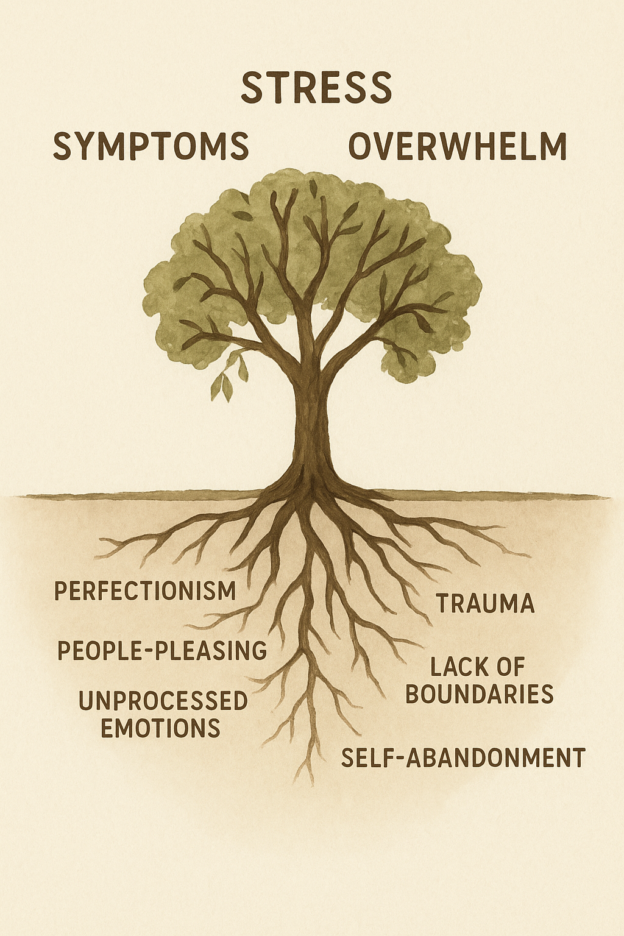
Our bodies don’t sound alarms for no reason. A dysregulated nervous system is often trying to tell us something. Here are some of the deeper, underlying causes that can keep a person stuck in chronic vigilance:

Emotional and Psychological Roots of Dysregulation

  • Perfectionism rooted in a belief that you’re never “good enough.”
  • Unprocessed emotions such as grief, anger, sadness, loneliness, or hurt.
  • Unresolved trauma or childhood neglect that created lasting beliefs of being unsafe or uncared for.
  • Lack of emotional safety in current work or relationship environments.
  • Growing up in chaos or unpredictability, leading to long-standing hypervigilance.
  • Internalized pressure to have no needs, resulting in people-pleasing, overfunctioning, or self-abandonment.

When these patterns are present, nervous system activation makes sense. It is trying to protect you from situations that echo past danger—or from present circumstances that feel overwhelming or unsustainable.

Why Regulation Techniques Aren’t Always Enough

Breathing exercises, grounding skills, or mindfulness practices can absolutely be helpful tools. They can settle your system in moments when you’re not actively being triggered. They can create space, reduce intensity, and help you reconnect with your body.

But expecting these techniques to fully resolve dysregulation—without addressing the underlying causes—is like turning down the volume on a fire alarm without checking for fire and then putting the fire out.

Often, true nervous system calming comes from the deeper work of changing behavioral patterns, relationships, environments, or beliefs that continually activate your stress response.

The Real Work of Re-Regulating Your Nervous System

Real inner calm grows from actions that are less about soothing and more about changing the conditions that keep your system overwhelmed. That might include:

  • Advocating for yourself in relationships or at work.
  • Tolerating healthy conflict and learning that it can be safe, instead of avoiding it.
  • Allowing yourself to feel grief, anger, sadness, or loss rather than pushing those emotions away.
  • Setting and honoring boundaries, even when it feels uncomfortable.
  • Addressing unhealthy or one-sided relationships, including the possibility of ending them.
  • Letting go of “shoulds” and making important decisions based on self-respect and your values, not pressure or fear.
  • Processing trauma so that your body can finally register that the danger is over.
  • Releasing the belief that your job is to keep everyone else happy at the cost of your own well-being.

These aren’t quick fixes. They are forms of emotional labor, self-advocacy, and true inner healing that change the very reasons the nervous system goes into fight-or-flight in the first place.

When the Body Isn’t Calm, There’s Usually a Reason

When you’re not feeling relaxed or grounded, it doesn’t necessarily mean you’re doing anything wrong. There may be a valid, very human reason that your system is activated. Your nervous system may be trying to say:

“Something in your life needs attention.”

Sometimes the most powerful nervous system regulation isn’t a technique—it’s a boundary.
Or an honest conversation.
Or letting yourself cry.
Or finally telling the truth about what hurts.
Or choosing yourself in a situation where you’ve habitually chosen everyone else.

Inner Calm Comes From Alignment, Not Perfection

Ultimately, nervous system regulation is less about mastering calming practices and more about aligning your life with your needs, your values, and your emotional truth.

When you feel safe to be yourself, safe to have needs, and safe to feel your feelings, your nervous system naturally settles.
Not because you forced it to—
but because it no longer has to protect you from things you are ignoring.

If you’d like help to achieve more calm in your nervous system, I’d be honored to help you. Contact Me, Or Schedule an appointment.

Share this on:

Coping with Anxiety Using Mindfulness

anxiety

You know the feeling when it starts: an unpleasant burning in your chest or abdomen, a feeling of cold on the back of your neck, tingling in your arms, or tightness in the back of your throat. Anxiety is a physical phenomenon.

Many of us are unaware of the specific physical sensations associated with our anxiety, but it sends a signal to our brain that we are in danger. On its own, anxiety tends to pass quickly and without much ado. It is the way we attribute meaning to the sensations in our body that causes anxiety to feel unbearable and to stick around. We interpret our anxiety as being “out of control.” We look to our environment or our thoughts for signals that we really are in danger, either physically or emotionally. And we beat ourselves up for feeling anxious, telling ourselves “What is wrong with me?” “Why can’t I feel calm?” And even worse, “I can’t tolerate feeling this way.”

But in reality, we can tolerate anxiety. By tolerating it and observing, without fear, and without judgment, its physical manifestations, we rob it of its power over us. And over time, anxiety will diminish if we refuse to escalate it by letting it take over our thoughts and our decisions. The quickest path to diminishing anxiety is to accept it and not to catastrophize about it or let it make our lives smaller.

Mindfulness is one of the most powerful tools for coping with and transforming anxiety. While it may feel like WE ARE anxious, bringing awareness to our body and choosing to focus on the specific physical sensations we are experiencing allows us to see that we are the observer of anxiety, not its victim. We can choose to halt self-defeating thoughts by returning awareness to our body and reminding ourselves “Anxiety cannot hurt me. It is only a feeling, and it is temporary. I am in control of myself. I can choose to be aware of the anxiety without letting it take over my thoughts.”

Practice doing mindfulness exercises such as this one when you are not feeling particularly anxious, as a way of being ready for anxiety when it comes. Learning to focus your full attention on your body rather than your thoughts takes some practice, but only five minutes a day can make a huge difference in reducing anxiety and helping you cope with it when it comes.

Anxiety is often associated with depression, even if the depression is not severe. Taking steps to address negative patterns of thinking, grieving losses, and learning to take better care of ourselves physically and emotionally is another important step in dealing with anxiety. If you need help to learn to identify and challenge negative thoughts, work through with past trauma or loss, or learn to improve your self-care and relationships, finding a therapist you trust is a great place to start.

Share this on:

Why Parents Should Nurture the Child Within, Too

Young woman on swing

Becoming a parent brings out so many new qualities in each of us. We learn to nurture selflessly. We learn patience and empathy. We learn to read the cues of our new baby, and how to meet their needs as best we can. It is an opportunity for growth like no other in our lifetime.

However, as we learn to give love and care to our child, many of us also begin to face the reality that we were not nurtured in certain ways in our own childhood. As we provide a loving mirror to our child, reflecting back a positive and validating image, we may become aware that we were not mirrored in a loving way ourselves. Perhaps we were shamed for certain qualities, or silenced when we voiced our truth, or in other ways shown that we were “not OK” the way we were.

Many of us have internalized shaming and dismissive attitudes directed at us as young children. We may not even realize that we continue the pattern by shaming or silencing ourselves. The child part within each of us, which is our source of joy, passion and creativity, is often stifled by our own inner shame. Our need for validation, love and nurturing are easily dismissed as “selfish” or “needy,” as we tell ourselves that we “shouldn’t” need the things the child inside us craves. The things we most enjoy and that give us pleasure are easily lost as we focus our attention on practical realities and the needs of others, especially our children and our partner.

This pattern of self-neglect fosters depression and chronic pain or physical symptoms. The child inside us loses hope that he or she will ever experience joy and fulfillment, contributing to depression. Or the child gets angry at being neglected and acts out, causing us to be resentful, irritable, or develop chronic symptoms (anxiety or somatic complaints) that tell us that all is not well in our inner world.  

This is how I understand my own struggle with anxiety and chronic symptoms as a mother raising my children. When I lost touch with the child inside me, as it is so easy to do while raising children, my anxiety mounted. If I continued to be what I believed a “good mother” was (e.g. selfless, endlessly patient and focused on the needs of others), the result was depression, painful physical symptoms, overeating, and other self-destructive patterns. What I came to discover was that by focusing my attention inward, and creating a loving dialog between my inner parent self and my inner child, I was able to heal those childhood wounds and feel a sense of balance and wholeness. 

Some clients of mine find that they can identify a clear inner parent and inner child voice. But for those who find it more difficult, the following exercise can be useful. You can communicate in the voice of your inner parent by writing with your dominant hand, and can reply as your inner child by writing with the non-dominant hand. It is amazing how easy it is for many people to access the child part of themselves when struggling to write with their non-dominant hand! If you have difficulty “hearing” your inner child voice, put your hand on your belly — that can help you access this vulnerable part.

You can start a dialog by asking “how are you doing?” or “how can I take care of you today?” or “what are you needing from me?” Some will find that the child inside them is quite angry and distrustful of the inner parent at first, for having neglected them for so long. But you can overcome this distrust by responding consistently in a loving parental voice, and reassuring the child inside you that you are there for them, that you will not leave them alone again, and that you love them just the way they are. You may not always be able to give your inner child what it wants in that moment, but just as we do with our children, we can learn to validate their needs and make sure that we create a life in which our inner child’s needs have some level of priority as well.

Here’s an example of an inner child dialog, that was initiated when the client found herself feeling very heavy and having back pain:

Parent: What are you needing from me today, Sweetie?

Child: I’m sad and I want to play with my friends, but I always have to work and take care of people.

Parent: I’m so sorry you’re sad. Working so much is really hard. We don’t have time to go play today, but I will make sure we have a couple of hours this weekend to go do something fun. You’re feelings matter to me, and I’m really glad you told me how you feel. Would asking [partner] for a hug help make this day easier?

Child: Yes, I like hugs. But I’m still sad.

Parent: I know, and it’s OK to be sad. Your feelings matter to me. Do you think a nice bath before bed would feel good?

Child: Yes, that’s good. Can I have bubbles and music?

Parent: Absolutely! I’m so proud of you for asking for what you need and I love you very much.

This exercise will allow you to begin a conversation that can allow you to experience a corrective emotional experience of being cared for and attended to, which can heal your heart in a very deep way. You can also learn how to create a balance between the needs of others and the needs of this tender part of yourself, which will allow you to live a more authentic, joyful life.

Share this on:

Perinatal Mental Health and Perfectionism

canstockphoto10868712

You’ve read the books. You’ve prepared the nursery. You’ve heard about Postpartum Depression—even if you may not see yourself as someone who’s likely to experience it. The commonly known risk factors for Perinatal Depression and other perinatal mental health disorders include:

  • A previous episode of depression or anxiety (especially during pregnancy)

  • A recent loss or major stressor, such as financial or health challenges

  • Lack of social support or relationship difficulties

  • A complicated pregnancy or birth, or breastfeeding challenges

Many of the clients I work with can check several of these boxes, and having one or two doesn’t guarantee you’ll struggle emotionally after birth. But there’s another risk factor that’s harder to measure—one that isn’t about what has happened to you, but about how you relate to yourself and the world.

Research shows that perfectionism and related personality traits can significantly increase the risk of postpartum depression. In particular, new parents who struggle the most with making mistakes are about four times more likely to experience postpartum emotional challenges. Also at higher risk are those who naturally prefer order, clarity, and control. This makes intuitive sense. Becoming a parent is the ultimate beginner’s role—messy, unpredictable, and often undertaken on very little sleep. If uncertainty or imperfection has always been hard for you, new parenthood can feel especially overwhelming.

In my practice, many of the new parents who struggle most aren’t just perfectionistic—they’re also used to taking responsibility for everyone else’s feelings and needs. That may work—barely—before a baby arrives. But a newborn instantly multiplies the emotional load. Babies cry. They will cry no matter how devoted, attentive, or skillful you are. And the more pressure you put on yourself to be a flawless parent, the more strained your energy and relationships can become. It’s a setup for stress, anxiety, and depression.

This is why learning to let go of perfection—in small, practical ways—can be powerful preparation for parenthood. Let the dishes wait a few hours. Run out of clean socks once in a while. Burn the rice because you got lost in a great article. Notice what’s going well instead of what could be better. Enjoy the sunshine in your half-landscaped yard. Allow people to be disappointed on occasion—after all, they disappoint you sometimes too. Practicing being good enough is not just healthy; it’s the foundation of sustainable, compassionate parenting.

If the idea of leaving a dish in the sink feels impossible, consider trying mindfulness practices or guided exercises. Mindfulness can help you accept what’s happening in the moment instead of feeling responsible for fixing everything. And you might benefit from support with a warm, understanding therapist (bonus points if their desk is a little messy). Learning to release some of the pressure you’ve carried for years is an investment in your well-being—and in the emotional health of your growing family.

Share this on:

Need Support? PSI is there to help!

Postpartum Support International is now offering even more online support meetings for pregnant and postpartum moms isolated at home. Check out the link below to find out more or to sign up.

https://www.postpartum.net/get-help/psi-online-support-meetings/

Take a test to see if you have Prenatal or Postpartum Depression

Share this on:

Perinatal Mental Health Disorders

Risk Factors, Symptoms, and What To Do

Take a Screening Test for Perinatal Mental Health Disorders

The Baby Blues has become as much an accepted part of being a new birthing parent as engorged breasts and sleep deprivation. But what if the Blues don’t go away? For 10-20% of new parents, a perinatal mental health disorder (PMHD) is an unwanted and difficult part of the first year of parenthood. The causes of PMHDs are many, and can include hormonal and lifestyle changes, a lack of social support, sleep deprivation, a high-risk pregnancy, a traumatic birth or difficult recovery, or breastfeeding problems. You are also at a higher risk of PMHDs if you have suffered previously from anxiety or depression, or have recent losses or trauma in your life. Symptoms of PMHDs can include:

  • Feeling sad, depressed, numb, or crying a lot
  • Restlessness or irritability
  • Excessive worrying or inability to relax
  • Unusually strong feelings of anger or resentment
  • Lack of energy
  • Having headaches, chest pains, heart palpitations, numbness, tingling, dizziness or nausea, hyperventilation or other unexplained physical symptoms
  • Difficulty sleeping or excessive tiredness
  • Loss of appetite or conversely, overeating and weight gain
  • Difficulty concentrating, remembering, and making decisions, or confusion
  • Excessive concern about the baby or lack of interest in the baby
  • Feelings of guilt and worthlessness
  • Lack of interest or pleasure in activities
  • Obsessive thoughts or compulsive behaviors
  • Fear of hurting the baby or yourself

Many new parents experience only a few of these symptoms, but if you feel like something is wrong and you’re not quite yourself, that is an important signal. If these symptoms persist for two weeks or more, you should promptly get support by talking to your doctor or a mental health professional. PMHDs are highly treatable, with therapy, medication, or a combination of the two.

If you need medication and you are told that you must give up breastfeeding, make sure you get the advice of a prescriber who is knowledgeable about medications for breastfeeding parents. There are a few antidepressants which are routinely prescribed during breastfeeding  with untraceable amounts detectable in the baby’s bloodstream. Moreover, breastfeeding can be beneficial both for the birthing parent, the long-term health of the baby, and bonding, which is even more challenging when a parent is depressed.

Depression not only affects you: it affects your relationships with your partner and your baby. Untreated, depression can lead to bonding difficulties and delayed development or failure to thrive. Getting the help you need to recover quickly is the best thing you can do for your baby and yourself.

Most importantly, tell your support people (your family, friends, partner) how you are feeling. The burden of trying to seem happy and “keeping it all together” can make the depression worse. You need to lean on the people who care about you, get as much help as you need until you’re back to feeling like yourself, and don’t beat yourself up for having a PMHD. It is NOT YOUR FAULT.

Share this on:

Letting Go of Parent Guilt

pregnant mom sonThere is no guilt quite like the guilt of a parent. We feel so uniquely responsible for the care of our children. Every lapse in our parenting weighs on us.

Throughout life there are always reasons to feel guilty: the call we forgot to return or the birthday card we forgot to send, or the time we snapped at our partner for no good reason. But when we feel we have failed with our child, this guilt weighs even heavier on our minds.

Guilt is an emotion with a conscience — it helps us try to do our best, and it reminds us of what is important to us. But too much guilt can rob us of enjoyment. And as a parent, there is so much to feel guilty about! If we dote on our child, there’s the house, friends, partner or even job to feel guilty about, and if we try to meet our other obligations, it is easy to feel that you have failed as a parent. It’s a Catch-22!

I wonder sometimes if our parents felt as guilty as we do, or if it is unique to our generation to expect so much from ourselves. And guilt in itself is purposeless. It doesn’t help anyone, but only makes it more difficult to do our best.

When you are feeling guilty, it is important to look at this feeling from some emotional distance, seeing it objectively instead of being its victim. Decide whether your sense of guilt is justified. Sometimes sharing your feelings with a fellow parent can help you sort out what is legitimate and what is perfectionism.

When you feel that you have truly let someone down, it is important to do what you can to make it right. Apologize to the friend you neglected, or the partner or child you yelled at. Try to learn from your guilt to change your priorities and do things differently. Then let the guilt go.

When the guilt is baseless, or unavoidable, like when you feel guilty for a feeling you have, or because you cannot do more than you are capable of, then you need to practice using your “interior parent” to counter those feelings.

If you had a beloved friend who told you she felt terrible because the baby cried while she was on a much-needed outing with her partner, what would you tell her? Probably you would reassure her that she is a wonderful mother, and that she must nurture herself and her relationship in order to be the best mother she can be. You would tell her she has nothing to feel guilty about, and you would also empathize with her pain. This is the role you must also play with yourself.

Listen to your own thoughts, and when they are self-defeating or judgmental, respond to yourself the way you would to a loved one — being a good parent to yourself is part of being a good, loving and joyful parent to your children.

Share this on:

My Journey Through Postpartum Depression and Panic Disorder

Whenever I talk about the symptoms of perinatal mood and anxiety disorders, I always include “unusual physical symptoms.” What does that mean? It means that any new physical symptoms that begin during pregnancy and postpartum can be related to mental health.

My own experience with postpartum depression and anxiety was quite atypical, and that was partly why I suffered for months before receiving the proper diagnosis and treatment.

I had lots of risk factors for postpartum depression: a previous bout of depression, the sudden loss of my mother only a few years before, a previous birth trauma, an unsupportive marriage, and breastfeeding difficulties. But even though I had suffered from depression before, after the death of my mother, my postpartum symptoms were not recognizable to me.

I did OK after my first child was born, although it was a difficult time for me. But after my second child, my stress level was off the charts. My older son was kicked out of two day care programs because he wouldn’t use the potty (he regressed after his brother was born). I never made enough milk for the new baby because of my stress level and because he was so big (born almost 10lbs) , and he refused to nurse completely as soon as he started solid foods. I felt guilty about “failing” at breastfeeding, and I was also afraid that I would not be able to go back to work after maternity leave because I couldn’t find daycare that would take my challenging and potty-resistant older son.

In the meantime, I had difficulties in my marriage. My husband worked long hours, and when he was there he criticized my parenting style, my cooking, and my housekeeping. Even our challenging preschooler was my fault! I was trying my best to make everyone happy, but I was clearly failing.

During this time, I started to have odd physical symptoms. I started feeling that the room was tilting and that I was off-balance. I had to lie down and felt the room was spinning around me. My doctor thought it was either an inner-ear infection or possibly Multiple Sclerosis, and I was sent for neurological testing. The tests came back normal, although MS couldn’t be ruled out (a bonus for my anxiety, of course!).

My symptoms came and went, and then began to include nausea and vomiting along with the dizziness, a complete lack of appetite, and an inability to sleep. I had a low-grade fever on and off for a couple of months and my white blood-cell count was high. I lost 16 pounds beyond the baby weight, slept about three to four hours a night, and threw up regularly — out the door of the car, in the sink at the pediatrician’s office, etc. I felt that my body was swaying even when I was perfectly still, and my bed felt like it was shaking as I lay in it trying to sleep. My skin felt prickly, my chest burned and my hands tingled. The dizziness made watching TV or reading impossible, and walking or driving became difficult. I felt sure that I was dying.

My doctor considered an inner ear problem, hormones, diabetes, thyroid issues, and even encephalitis, but every test came back normal. I was living on Ensure and Gatorade, because I couldn’t keep any solid food down. The stress of caring for my children became unbearable, so we hired a babysitter and I spent most of every day lying in bed, praying to fall asleep for a couple of hours to get some rest. I was prescribed Ativan, but it just knocked me out for an hour or two and I would wake up feeling even worse than before.

After about four months, I fell apart completely and told my doctor that he had to hospitalize me because I was dying, and at that point I wanted to die if they couldn’t stop the misery I was living in. I was admitted to a psychiatric inpatient unit, but my doctor was still sending me around to specialists, trying to figure out what was physically wrong with me.

I stopped vomiting as soon as I was admitted to the hospital. That was when I realized that whatever was going on with me had to do with stress. I spent 12 days in the hospital, during which time I started taking antidepressants and was prescribed an anti-anxiety medication that allowed me to sleep. For a few days, all I did was sleep. When I was awake I was no longer nauseous, but I was filled with unbearable emotional pain. I was terrified that I would never be able to care for my children without getting sick. I felt like the worst mother in the world.

After I was released from the hospital I did a full-day partial hospitalization program for a month, which gave me time for the antidepressant to start working and allowed me to take care of myself for a change. I learned in group therapy about the ways in which I had prioritized my responsibility for others way above self-care, in unhealthy and unhelpful ways, and I began to heal. With the help of medication, therapy, and later couples counseling, I recovered. I still had anxiety at times, but I also had joy and passion for life. I became a lactation educator, started a small business helping other new moms, and led new parent support groups for several years. Eight years later I went back to school to become a Marriage and Family Therapist.

I still have to be vigilant about managing stress and maintaining good self-care. I tell myself that this is the “gift” of being prone to depression and anxiety: I don’t have the luxury of tolerating a great deal of stress like some people seem to do, or living life in a way that generally makes me unhappy. I am obligated to do work that I love, to have a healthy relationship with my husband, and to prioritize joy, peace and comfort as well as caring for my family. I know that I always have to be mindful to avoid a recurrence of depression, but I also know that I am strong and resilient and will do whatever I have to do to be healthy and take good care of myself and my children.

My mental health issues began when my second child was seven months old, and yet no one ever considered a postpartum condition. My symptoms were fully consistent with panic disorder and depression, and yet my doctor and my therapist (yes, a trained therapist!) never considered these diagnoses. My hope is that in the future, mothers and their caregivers become better educated to recognize perinatal mood and anxiety disorders so that they can be treated early and mothers can return to enjoying their lives again.

  • If you need immediate help, please call the National Suicide Hotline at 1-800-273-TALK (8255)
  • If you are looking for pregnancy or postpartum support and local resources, please call or email Postpartum Support International:

Call PSI Warmline (English & Spanish) 1-800-944-4PPD (4773)
Email support@postpartum.net

Take a test to see if you have Prenatal or Postpartum Depression

Share this on:

Antidepressants: Yay or Nay?

canstockphoto19841317For individuals who have struggled with depression, the decision of whether to try, or later to stay on antidepressant medication is often a difficult one. Some people swear they will never try an antidepressant, until or unless their depression becomes so debilitating that there seems to be no other option. For others, the promise of relief is so attractive that they jump into the decision to take antidepressants, but then they struggle with the question of whether the medication is a lifelong sentence.

To Take Antidepressants or Not to Take Antidepressants

There are no easy answers to this question (as is true for most important ones!). Studies show that individuals suffering from moderate to severe depression have better odds of recovery with a combination of therapy and antidepressants. However, for some people, changes in diet, additional exercise, and better strategies for coping with stress can work just as well. For debilitating depression, medication can often help to lift a person up enough to be able to meaningfully participate in therapy. But depression generally happens for a reason, and often changes in thinking patterns, relationships or career are necessary for a person to have more happiness and fulfillment in their life. Medication alone may not make these changes happen. Does relying on antidepressants to make life more bearable reduce the motivation to make needed life changes that will improve the quality of one’s life? The answer to that question may be different for every individual, and is something that can be explored in therapy.

Side Effects

Some individuals find great relief on antidepressants, and don’t have any bothersome side effects. But others experience weight gain, sexual side effects or other unwanted secondary effects from these drugs. Sometimes, switching medication can resolve these issues, but in some cases the antidepressants that work for the individual are the same ones that cause other problems. That is a common reason why some people consider going off medication and try to manage their depression in other ways.

Never Go Off Antidepressants Without Consulting Your Doctor

A reminder here is important; never go off antidepressant medication suddenly, or without the supervision of the prescribing doctor. Some of these drugs require an extended period of weaning to avoid serious withdrawal symptoms. And an important factor to consider is the possibility that if you wean off your antidepressant medication, the same medication may not work for you as well in the future. That is one factor that you need to weigh with your health provider when making this decision.

Issues Raised by Weaning Off Antidepressants

Individuals that decide in consultation with their doctor to wean off antidepressants face a whole other set of challenges. The fear of a relapse of depression can be the most difficult part. Coping with the symptoms of withdrawal can be challenging, and often brings up these fears. Also, people who go off antidepressant medication may find themselves more vulnerable to feelings of sadness, irritation, anger and stress than they are used to. Learning coping strategies for these emotions is very important. A really bad day can create a lot of anxiety that the depression may be returning, even if the emotions involved are normal and healthy. Therapy can be an helpful place for reality-testing in terms of what is healthy and what is a signal that depression may be returning.

The thoughts and feelings around the decision to go on or off of antidepressant medication can be confusing. Therapy and consultation with your medical provider to sort through the questions and concerns raised by antidepressants is a good place to start.

Share this on: