What neuroscience is teaching us about chronic pain — and the treatment that’s changing lives.
Many years ago, I went through a two-year period with chronic tendinitis in my wrists. During those years there were countless days when I couldn’t type, garden, cook, or even open doors or jars without excruciating pain. I saw my doctor and went to physical therapy for over a year. I stretched, I rested, I iced, I splinted. Nothing really shifted.
I overcame my wrist symptoms after reading a book called Healing Back Pain by Dr. John Sarno, which convinced me that my wrists weren’t damaged. At the time, that was enough — the pain gradually faded and I moved on.
It wasn’t until I got trained in Pain Reprocessing Therapy (PRT) in 2021 that I looked back and understood the fuller picture.
If you’ve struggled with chronic pain or symptoms, there may be a deeper need beneath the surface—one that, when finally met, may be the missing piece in your recovery
I have been working with a client recently who recovered remarkably quickly from disabling pain and other symptoms. She hadn’t been able to work or care for herself for quite a while. She had moved home with a parent and needed help with even small tasks, such as taking a shower, pouring herself a glass of water, or opening doors. She was unable to use her phone because of debilitating pain in her hands.
She was highly motivated to heal, as you can imagine.
She is now living independently, driving herself to work, doing a job that involves lots of work on a laptop, and using her phone too much (like the rest of us!)
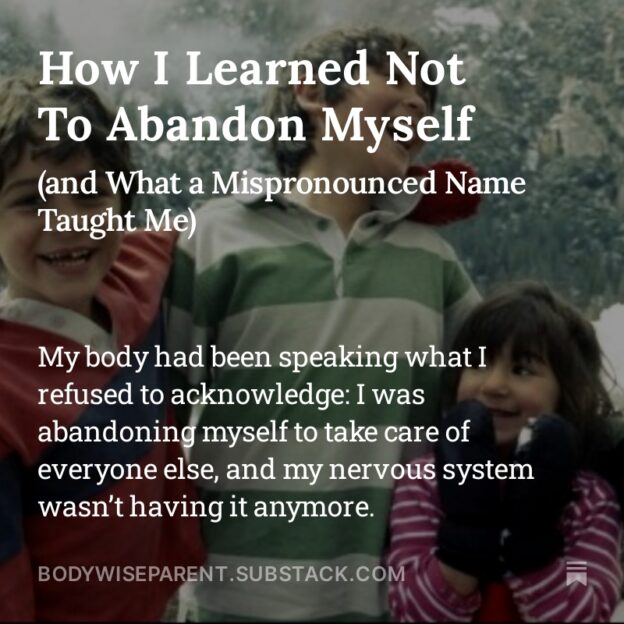
My body had been speaking what I refused to acknowledge: I was abandoning myself to take care of everyone else, and my nervous system wasn’t having it anymore.
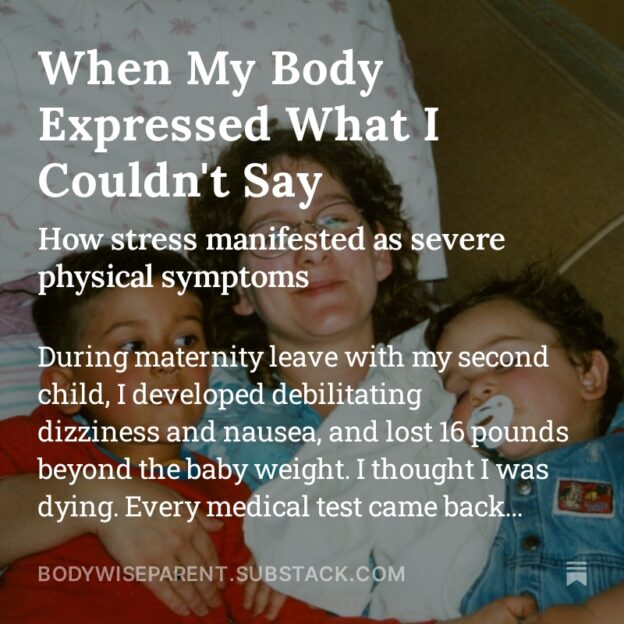
While postpartum with my second child, I was hospitalized for severe depression and anxiety after suffering months of chronic dizziness and nausea. I was released from the hospital after twelve days of inpatient treatment. During those days, I kept solid food down for the first time in months, started to have an appetite, and was just beginning to be able to sleep through the night. I was seeing a light at the end of the tunnel.
When I got home and was back in the stressful environment I had left, I immediately felt like no recovery had occurred at all. My husband expected me to be back to 100% right away, and every stressful moment, even the sound of my son’s voice (needing something from me!), caused a wave of dread, dizziness and nausea to come right back. Clearly, I hadn’t fully recovered yet. So I got put in a full-day intensive outpatient program for six weeks, so I could ease back into “life on the outside.”
Emotional Awareness & Expression Handout for Anxiety and Pain or Symptoms
For people learning to acknowledge, allow and express emotions as a way of calming their nervous system and diminishing chronic pain or other symptoms.
For those of you learning to overcoming perfectionism in your parenting, so you can be a “good enough parent,” and give your children the benefits of experiencing frustration, advocating for themselves, and can develop a greater sense of their own capabilities.
For those of you learning to overcoming the habit of “problem-solving mode,” to learn to tolerate uncomfortable physical sensations and difficult emotions and teach your brain that you are safe, to calm your nervous system and overcome anxiety, chronic pain and neuroplastic symptoms.
A supportive, empowering message to women who have had their pain and symptoms dismissed for far too long.
For generations, possibly since the advent of modern medicine, women’s health concerns have been minimized, misunderstood, or dismissed outright. Women have been labeled “hysterical,” “dramatic,” or “too sensitive” when they were suffering with very real physical conditions. Many of us have been told our symptoms are “all in our heads,” that we’re overreacting, and that we simply need to calm down or push through. Or to “just get over it.”
Given that history, it is completely understandable that the idea of mind–body healing can feel uncomfortable or even insulting. For many women, it appears to echo the same harmful messages we’ve heard their whole lives: “You’re imagining it.” “It’s your fault.” “Just get over it.” That’s the opposite of what women deserve.
Women are not “more emotional.” We are more burdened.
Women experience higher rates of chronic pain, autoimmune illness, migraines, IBS, fatigue disorders, anxiety, and other stress-related conditions—not because we are weaker or more fragile–in fact, just the opposite! It is very likely that these conditions impact women more because we often carry more:
Caregiving responsibilities
Emotional labor at home and at work
Discrimination and microaggressions
Financial and workplace instability
Exposure to trauma and unsafe relationships
Pressure to be accommodating, calm, kind, and self-sacrificing
Women are often expected to perform at work as if we don’t have families, and at home as if we don’t have jobs. We are trained to consider others’ needs before their own. We are told to smile through pain and stay “pleasant,” no matter what we’re carrying. A body under those conditions will eventually speak up. Often through pain or symptoms.
When symptoms are neuroplastic, they’re not imaginary
Pain or symptoms that are created or maintained by the brain are not “made up,” “in your head,” or less legitimate or impactful. It simply means the nervous system has become overwhelmed and has created the symptom as an act of self-protection. The brain is incredibly powerful, and it can create real:
pain
inflammation
skin conditions
digestive issues
dizziness
fatigue
nausea
sensitivities to foods, sounds, light and chemicals
sensations of numbness, tingling, itching and burning, and others
Not with willpower. Not with “pushing through.” Not with being a “good patient.” Not with pretending you’re fine. But with approaches that calm and retrain the brain, address stress and overwhelm, restore agency, and bring your system back into balance.
Why women often hesitate to embrace mind–body neuroplastic treatments:
Women have excellent reasons to be cautious. We’ve often been dismissed by providers or been given answers and treatments that were not helpful or that made things worse. We’re often told that our symptoms are due to stress without receiving support to address the root cause. We’ve lacked adequate care, support, or time to heal. We haven’t had our suffering taken seriously.
So when someone says, “Your pain may be neuroplastic,” many women understandably hear: “You’re imagining it,” or “It’s up to you to fix it alone.” But in truth, neuroplastic healing is one of the most validating approaches available, because it says: “Your symptoms are real, your suffering is legitimate, and your healing matters.”
Mind–body healing is not self-blame — it is self-restoration.
Neuroplastic treatments do not ask women to ignore structural medical issues that need treatment, and they are not based on the idea that pain or discomfort is “all in your head.” What mind-body healing does do is empower women with tools that have been proven to reduce or eliminate chronic pain and other symptoms by addressing the overloaded nervous systems that so many women live with every day.
Healing happens through:
Learning to feel safe in your body again
Setting boundaries where life has demanded too much
Addressing perfectionistic or self-sacrificial patterns that make life difficult
Giving yourself the compassion you rarely receive from others
Processing emotions you’ve had to suppress to survive
Reclaiming agency over your health and wellbeing
It is about restoring your sense of safety and learning to live in a way that allows you to feel your feelings, prioritize your well-being, and live in a more authentic way. Living more authentically allows your nervous system to thrive and allows you to engage with life in a more joyful way.
You deserve a healing path that sees the whole you
Mind–body healing is not a message that something is wrong with you. It is a message that you’ve likely carried too much, and it’s taken a toll on your well-being. Your symptoms — painful, frustrating, frightening as they are — are your body’s way of saying: “I’ve been carrying too much for too long.” “I need care just as much as I give it.” “I deserve safety, rest, and support.” You deserve to feel fully supported as you reclaim your health, your agency, and your well-being.
There’s a lot of talk these days about the importance of “nervous system regulation.” We often hear that when the body is in fight-or-flight mode, the brain interprets danger signals and may create physical symptoms or anxiety as a protective response. This is true—but it’s only part of the story.
What often gets overlooked is that nervous system regulation doesn’t always happen directly. We can’t always breathe, meditate, or stretch our way out of fight-or-flight, especially if our bodies are sounding an alarm for a real and valid reason. Sometimes the issue isn’t that we don’t know how to calm down—it’s that something in our lives is keeping us stuck in a state of tension.
So instead of asking, “How do I calm my nervous system?” it can be more helpful to ask: “Why is is my nervous system activated in the first place?”
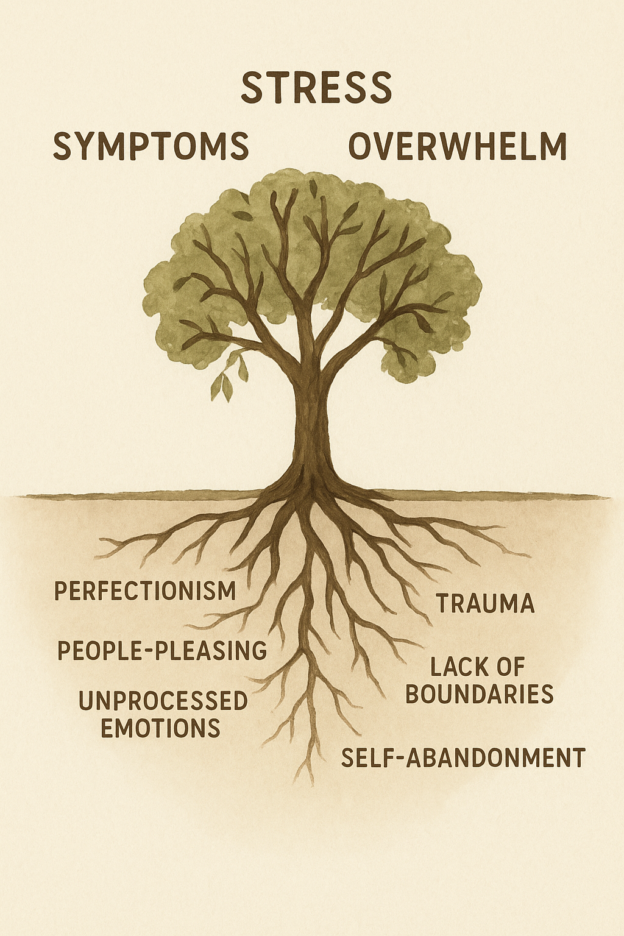
Our bodies don’t sound alarms for no reason. A dysregulated nervous system is often trying to tell us something. Here are some of the deeper, underlying causes that can keep a person stuck in chronic vigilance:
Emotional and Psychological Roots of Dysregulation
Perfectionism rooted in a belief that you’re never “good enough.”
Unprocessed emotions such as grief, anger, sadness, loneliness, or hurt.
Unresolved trauma or childhood neglect that created lasting beliefs of being unsafe or uncared for.
Lack of emotional safety in current work or relationship environments.
Growing up in chaos or unpredictability, leading to long-standing hypervigilance.
Internalized pressure to have no needs, resulting in people-pleasing, overfunctioning, or self-abandonment.
When these patterns are present, nervous system activation makes sense. It is trying to protect you from situations that echo past danger—or from present circumstances that feel overwhelming or unsustainable.
Why Regulation Techniques Aren’t Always Enough
Breathing exercises, grounding skills, or mindfulness practices can absolutely be helpful tools. They can settle your system in moments when you’re not actively being triggered. They can create space, reduce intensity, and help you reconnect with your body.
But expecting these techniques to fully resolve dysregulation—without addressing the underlying causes—is like turning down the volume on a fire alarm without checking for fire and then putting the fire out.
Often, true nervous system calming comes from the deeper work of changing behavioral patterns, relationships, environments, or beliefs that continually activate your stress response.
The Real Work of Re-Regulating Your Nervous System
Real inner calm grows from actions that are less about soothing and more about changing the conditions that keep your system overwhelmed. That might include:
Advocating for yourself in relationships or at work.
Tolerating healthy conflict and learning that it can be safe, instead of avoiding it.
Allowing yourself to feel grief, anger, sadness, or loss rather than pushing those emotions away.
Setting and honoring boundaries, even when it feels uncomfortable.
Addressing unhealthy or one-sided relationships, including the possibility of ending them.
Letting go of “shoulds” and making important decisions based on self-respect and your values, not pressure or fear.
Processing trauma so that your body can finally register that the danger is over.
Releasing the belief that your job is to keep everyone else happy at the cost of your own well-being.
These aren’t quick fixes. They are forms of emotional labor, self-advocacy, and true inner healing that change the very reasons the nervous system goes into fight-or-flight in the first place.
When the Body Isn’t Calm, There’s Usually a Reason
When you’re not feeling relaxed or grounded, it doesn’t necessarily mean you’re doing anything wrong. There may be a valid, very human reason that your system is activated. Your nervous system may be trying to say:
“Something in your life needs attention.”
Sometimes the most powerful nervous system regulation isn’t a technique—it’s a boundary. Or an honest conversation. Or letting yourself cry. Or finally telling the truth about what hurts. Or choosing yourself in a situation where you’ve habitually chosen everyone else.
Inner Calm Comes From Alignment, Not Perfection
Ultimately, nervous system regulation is less about mastering calming practices and more about aligning your life with your needs, your values, and your emotional truth.
When you feel safe to be yourself, safe to have needs, and safe to feel your feelings, your nervous system naturally settles. Not because you forced it to— but because it no longer has to protect you from things you are ignoring.
A Balanced Approach to Physical Symptoms in Therapy
Today, a fellow therapist asked me, “Aren’t you worried about treating someone as if they have neuroplastic symptoms when they actually have a serious medical condition?”
This question raised a lot of interesting thoughts for me. So welcome to my TED Talk!
Firstly, the vast majority of people who seek treatment for neuroplastic symptoms already have seen all the doctors. Rather than not being evaluated medically, the much more common scenario is that they have seen all the mainstream doctors they can get referrals for. They may also have seen a few nontraditional practitioners as well. They have likely heard from their doctors that there’s nothing that can be done medically, or have tried all the recommended medical treatments, or have gotten sick and tired of spending all their money and time on alternative treatments.
Moreover, some neuroplastic conditions present in a way that doesn’t lend itself to a medical diagnosis. Symptoms might move around randomly, from one part of the body to another. They might hurt the day after exercise, but not during it. Or pain might start right when they walk into the gym. Or symptoms may have started simultaneously in both hands or both shoulders. Or they may happen only when it rains, or during the full moon, or on Monday mornings. Those are conditions that doctors just shrug their shoulders at.
Or they may happen only when it rains, or during the full moon, or on Monday mornings. Those are conditions that doctors just shrug their shoulders at.
Furthermore, it occurred to me that therapists don’t worry about this very much when they’re treating neuroplastic conditions that appear psychological, such as depression – even though that can also be caused by a medical condition. I always make sure my clients with depression, anxiety or insomnia have had a full physical exam and labs done, since I don’t want to find out a year into treatment that a client is hypothyroid or has a deficiency. It’s always important to make sure our clients are getting adequate medical care – whether or not they are being treated for physical symptoms.
When I developed debilitating neuroplastic dizziness, vertigo, nausea, vomiting and insomnia, my doctor spent months trying to figure out what was medically wrong with me. I had many rounds of lab tests done, a trip to a neurologist, and an MRI. Every test was normal. All that accomplished was delaying my recovery, and I ended up hospitalized with Major Depressive Disorder after being unable to eat or sleep for several months.
That’s not to say that those tests didn’t need to be done, but it wouldn’t have hurt for me to be getting support from a mind-body therapist at the same time.
The truth is that you don’t have to choose between being medically evaluated and receiving treatment for neuroplastic symptoms. Your doctor should treat your symptoms as legitimate, and should run any and all diagnostic tests needed and refer you to any appropriate specialists. AND, whenever it becomes apparent that there may be a neuroplastic component to your symptoms, mind-body treatments should be pursued. If they work, then it is clear that your symptoms were neuroplastic all along.
To find out if mind-body treatment can help you overcome your chronic symptoms, Contact Me.
Pregnancy and the postpartum period are very vulnerable times. Our bodies change in ways that can feel scary and uncomfortable. It’s also a time when a lot of birthing people experience somatic complaints. Symptoms often include morning sickness and the typical aches and pains of pregnancy and new parenthood. But they can also include sciatica, vertigo, migraine, heartburn, wrist pain, back and neck pain, and even Hyperemesis Gravidarum (severe nausea and vomiting during pregnancy). These symptoms can be scary, and they can make us believe that there is something seriously wrong with our bodies.
When we are experiencing symptoms that scare us, that fear turns up the dial on our perception of those sensations. And those of us who tend to experience these symptoms the most during pregnancy and the postpartum period are folks who “somatize” our stress and emotions — often those of us who’ve experienced childhood adversity and who are also susceptible to depression and anxiety.
I am one of those people. I’ve struggled with chronic symptoms since childhood, including asthma, IBS, TMJ pain, wrist pain, bladder symptoms, etc. But after the birth of my second child, my physical symptoms were the worst I had ever faced. My postpartum anxiety presented as somatic symptoms—constant, overwhelming dizziness and nausea that made it difficult caused me to be unable to care for my children. At the time, I didn’t connect these symptoms to stress or self-neglect, but in hindsight, they were clear signs that I needed better boundaries and self-care. With therapy and support, I learned to prioritize my own well-being, and slowly recovered.
I now know how common it is for new and expecting parents to experience both psychological and physical symptoms during the perinatal period. It’s an incredibly vulnerable time, and stress commonly shows up in the body. The good news is that these symptoms—whether depression, anxiety, vertigo, or pain conditions like headaches, dizziness, wrist tendinitis, neck pain or sciatica—are highly treatable.
As a therapist specializing in perinatal mental health and neuroplastic symptom recovery, I help clients heal both physically and emotionally, so they can return to the full, balanced life they deserve. How we engage with our physical symptoms can either exacerbate or heal them. Pain Reprocessing Therapy teaches us how to view physical sensations from a lens of safety, so sensations are not amplified. And Emotional Awareness and Expression Therapy helps us release strong emotions that can contribute to tension and symptoms in the body.
Psychotherapy can also support birthing people in learning to prioritize our own well-being as we are learning to care for our babies. Not abandoning ourselves while caring for our family helps us become healthy parents in body, mind, and spirit.
Take this Quiz to help you determine if your chronic symptoms are likely neuroplastic.
Share this on:
Cookie Consent
We use cookies to improve your experience on our site. By using our site, you consent to cookies.
ID used to identify users for 24 hours after last activity
24 hours
_gat
Used to monitor number of Google Analytics server requests when using Google Tag Manager
1 minute
_gali
Used by Google Analytics to determine which links on a page are being clicked
30 seconds
_ga_
ID used to identify users
2 years
__utmv
Contains custom information set by the web developer via the _setCustomVar method in Google Analytics. This cookie is updated every time new data is sent to the Google Analytics server.
2 years after last activity
__utmx
Used to determine whether a user is included in an A / B or Multivariate test.
18 months
_ga
ID used to identify users
2 years
__utmc
Used only with old Urchin versions of Google Analytics and not with GA.js. Was used to distinguish between new sessions and visits at the end of a session.
End of session (browser)
__utmz
Contains information about the traffic source or campaign that directed user to the website. The cookie is set when the GA.js javascript is loaded and updated when data is sent to the Google Anaytics server
6 months after last activity
__utma
ID used to identify users and sessions
2 years after last activity
__utmt
Used to monitor number of Google Analytics server requests
10 minutes
__utmb
Used to distinguish new sessions and visits. This cookie is set when the GA.js javascript library is loaded and there is no existing __utmb cookie. The cookie is updated every time data is sent to the Google Analytics server.
30 minutes after last activity
_gac_
Contains information related to marketing campaigns of the user. These are shared with Google AdWords / Google Ads when the Google Ads and Google Analytics accounts are linked together.
90 days
Marketing cookies are used to follow visitors to websites. The intention is to show ads that are relevant and engaging to the individual user.
Google Maps is a web mapping service providing satellite imagery, real-time navigation, and location-based information.