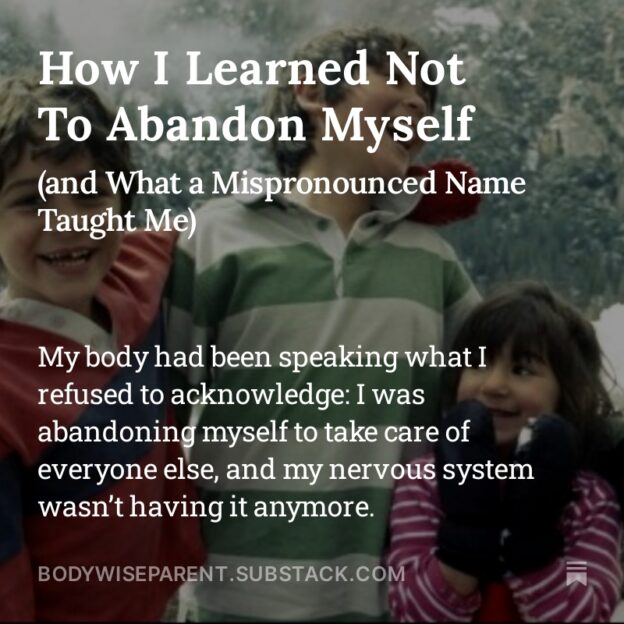
My body had been speaking what I refused to acknowledge: I was abandoning myself to take care of everyone else, and my nervous system wasn’t having it anymore.
While postpartum with my second child, I was hospitalized for severe depression and anxiety after suffering months of chronic dizziness and nausea. I was released from the hospital after twelve days of inpatient treatment. During those days, I kept solid food down for the first time in months, started to have an appetite, and was just beginning to be able to sleep through the night. I was seeing a light at the end of the tunnel.
When I got home and was back in the stressful environment I had left, I immediately felt like no recovery had occurred at all. My husband expected me to be back to 100% right away, and every stressful moment, even the sound of my son’s voice (needing something from me!), caused a wave of dread, dizziness and nausea to come right back. Clearly, I hadn’t fully recovered yet. So I got put in a full-day intensive outpatient program for six weeks, so I could ease back into “life on the outside.”
Emotional Awareness & Expression Handout for Anxiety and Pain or Symptoms
For people learning to acknowledge, allow and express emotions as a way of calming their nervous system and diminishing chronic pain or other symptoms.
For those of you learning to overcoming perfectionism in your parenting, so you can be a “good enough parent,” and give your children the benefits of experiencing frustration, advocating for themselves, and can develop a greater sense of their own capabilities.
For those of you learning to overcoming the habit of “problem-solving mode,” to learn to tolerate uncomfortable physical sensations and difficult emotions and teach your brain that you are safe, to calm your nervous system and overcome anxiety, chronic pain and neuroplastic symptoms.
A supportive, empowering message to women who have had their pain and symptoms dismissed for far too long.
For generations, possibly since the advent of modern medicine, women’s health concerns have been minimized, misunderstood, or dismissed outright. Women have been labeled “hysterical,” “dramatic,” or “too sensitive” when they were suffering with very real physical conditions. Many of us have been told our symptoms are “all in our heads,” that we’re overreacting, and that we simply need to calm down or push through. Or to “just get over it.”
Given that history, it is completely understandable that the idea of mind–body healing can feel uncomfortable or even insulting. For many women, it appears to echo the same harmful messages we’ve heard their whole lives: “You’re imagining it.” “It’s your fault.” “Just get over it.” That’s the opposite of what women deserve.
Women are not “more emotional.” We are more burdened.
Women experience higher rates of chronic pain, autoimmune illness, migraines, IBS, fatigue disorders, anxiety, and other stress-related conditions—not because we are weaker or more fragile–in fact, just the opposite! It is very likely that these conditions impact women more because we often carry more:
Caregiving responsibilities
Emotional labor at home and at work
Discrimination and microaggressions
Financial and workplace instability
Exposure to trauma and unsafe relationships
Pressure to be accommodating, calm, kind, and self-sacrificing
Women are often expected to perform at work as if we don’t have families, and at home as if we don’t have jobs. We are trained to consider others’ needs before their own. We are told to smile through pain and stay “pleasant,” no matter what we’re carrying. A body under those conditions will eventually speak up. Often through pain or symptoms.
When symptoms are neuroplastic, they’re not imaginary
Pain or symptoms that are created or maintained by the brain are not “made up,” “in your head,” or less legitimate or impactful. It simply means the nervous system has become overwhelmed and has created the symptom as an act of self-protection. The brain is incredibly powerful, and it can create real:
pain
inflammation
skin conditions
digestive issues
dizziness
fatigue
nausea
sensitivities to foods, sounds, light and chemicals
sensations of numbness, tingling, itching and burning, and others
Not with willpower. Not with “pushing through.” Not with being a “good patient.” Not with pretending you’re fine. But with approaches that calm and retrain the brain, address stress and overwhelm, restore agency, and bring your system back into balance.
Why women often hesitate to embrace mind–body neuroplastic treatments:
Women have excellent reasons to be cautious. We’ve often been dismissed by providers or been given answers and treatments that were not helpful or that made things worse. We’re often told that our symptoms are due to stress without receiving support to address the root cause. We’ve lacked adequate care, support, or time to heal. We haven’t had our suffering taken seriously.
So when someone says, “Your pain may be neuroplastic,” many women understandably hear: “You’re imagining it,” or “It’s up to you to fix it alone.” But in truth, neuroplastic healing is one of the most validating approaches available, because it says: “Your symptoms are real, your suffering is legitimate, and your healing matters.”
Mind–body healing is not self-blame — it is self-restoration.
Neuroplastic treatments do not ask women to ignore structural medical issues that need treatment, and they are not based on the idea that pain or discomfort is “all in your head.” What mind-body healing does do is empower women with tools that have been proven to reduce or eliminate chronic pain and other symptoms by addressing the overloaded nervous systems that so many women live with every day.
Healing happens through:
Learning to feel safe in your body again
Setting boundaries where life has demanded too much
Addressing perfectionistic or self-sacrificial patterns that make life difficult
Giving yourself the compassion you rarely receive from others
Processing emotions you’ve had to suppress to survive
Reclaiming agency over your health and wellbeing
It is about restoring your sense of safety and learning to live in a way that allows you to feel your feelings, prioritize your well-being, and live in a more authentic way. Living more authentically allows your nervous system to thrive and allows you to engage with life in a more joyful way.
You deserve a healing path that sees the whole you
Mind–body healing is not a message that something is wrong with you. It is a message that you’ve likely carried too much, and it’s taken a toll on your well-being. Your symptoms — painful, frustrating, frightening as they are — are your body’s way of saying: “I’ve been carrying too much for too long.” “I need care just as much as I give it.” “I deserve safety, rest, and support.” You deserve to feel fully supported as you reclaim your health, your agency, and your well-being.
Becoming a parent brings out so many new qualities in each of us. We learn to nurture selflessly. We learn patience and empathy. We learn to read the cues of our new baby, and how to meet their needs as best we can. It is an opportunity for growth like no other in our lifetime.
However, as we learn to give love and care to our child, many of us also begin to face the reality that we were not nurtured in certain ways in our own childhood. As we provide a loving mirror to our child, reflecting back a positive and validating image, we may become aware that we were not mirrored in a loving way ourselves. Perhaps we were shamed for certain qualities, or silenced when we voiced our truth, or in other ways shown that we were “not OK” the way we were.
Many of us have internalized shaming and dismissive attitudes directed at us as young children. We may not even realize that we continue the pattern by shaming or silencing ourselves. The child part within each of us, which is our source of joy, passion and creativity, is often stifled by our own inner shame. Our need for validation, love and nurturing are easily dismissed as “selfish” or “needy,” as we tell ourselves that we “shouldn’t” need the things the child inside us craves. The things we most enjoy and that give us pleasure are easily lost as we focus our attention on practical realities and the needs of others, especially our children and our partner.
This pattern of self-neglect fosters depression and chronic pain or physical symptoms. The child inside us loses hope that he or she will ever experience joy and fulfillment, contributing to depression. Or the child gets angry at being neglected and acts out, causing us to be resentful, irritable, or develop chronic symptoms (anxiety or somatic complaints) that tell us that all is not well in our inner world.
This is how I understand my own struggle with anxiety and chronic symptoms as a mother raising my children. When I lost touch with the child inside me, as it is so easy to do while raising children, my anxiety mounted. If I continued to be what I believed a “good mother” was (e.g. selfless, endlessly patient and focused on the needs of others), the result was depression, painful physical symptoms, overeating, and other self-destructive patterns. What I came to discover was that by focusing my attention inward, and creating a loving dialog between my inner parent self and my inner child, I was able to heal those childhood wounds and feel a sense of balance and wholeness.
Some clients of mine find that they can identify a clear inner parent and inner child voice. But for those who find it more difficult, the following exercise can be useful. You can communicate in the voice of your inner parent by writing with your dominant hand, and can reply as your inner child by writing with the non-dominant hand. It is amazing how easy it is for many people to access the child part of themselves when struggling to write with their non-dominant hand! If you have difficulty “hearing” your inner child voice, put your hand on your belly — that can help you access this vulnerable part.
You can start a dialog by asking “how are you doing?” or “how can I take care of you today?” or “what are you needing from me?” Some will find that the child inside them is quite angry and distrustful of the inner parent at first, for having neglected them for so long. But you can overcome this distrust by responding consistently in a loving parental voice, and reassuring the child inside you that you are there for them, that you will not leave them alone again, and that you love them just the way they are. You may not always be able to give your inner child what it wants in that moment, but just as we do with our children, we can learn to validate their needs and make sure that we create a life in which our inner child’s needs have some level of priority as well.
Here’s an example of an inner child dialog, that was initiated when the client found herself feeling very heavy and having back pain:
Parent: What are you needing from me today, Sweetie?
Child: I’m sad and I want to play with my friends, but I always have to work and take care of people.
Parent: I’m so sorry you’re sad. Working so much is really hard. We don’t have time to go play today, but I will make sure we have a couple of hours this weekend to go do something fun. You’re feelings matter to me, and I’m really glad you told me how you feel. Would asking [partner] for a hug help make this day easier?
Child: Yes, I like hugs. But I’m still sad.
Parent: I know, and it’s OK to be sad. Your feelings matter to me. Do you think a nice bath before bed would feel good?
Child: Yes, that’s good. Can I have bubbles and music?
Parent: Absolutely! I’m so proud of you for asking for what you need and I love you very much.
This exercise will allow you to begin a conversation that can allow you to experience a corrective emotional experience of being cared for and attended to, which can heal your heart in a very deep way. You can also learn how to create a balance between the needs of others and the needs of this tender part of yourself, which will allow you to live a more authentic, joyful life.
There are so many things we benefit from learning to let go of as parents — comparing our child or our home to others’, expecting our child to become the exact person we imagined, attempting to be a perfect housekeeper/caregiver/playmate/chef/lover (insert unrealistic expectation here), and on some days, even expecting to take a shower!
How do we do it? Often I hear from clients that this is one of the most difficult parts of being a parent — letting go of control and the need for things to be perfect. We hold on so tightly, imagining that this holding on is the only thing keeping everything from falling apart, or keeping us from falling apart. And yet it is often this unrealistic desire for control that causes us (and then inevitably, things) to fall apart.
What it comes down to, in my view, is the belief that we live in a friendly universe. Whether it’s objectively true or not is irrelevant. We benefit from cultivating the belief that things are OK. That we and the people we love are OK. That even when things are not OK, it’s still OK.
Our need for control is rooted in a fear that is far greater than the things we fear. We imagine that if we don’t clean up the house, not only will the house be messy, but it feels like the world will end. We fear that if we don’t wash our child’s hands, not only may she get sick, but we won’t be able to cope. If our child falls behind in development, we imagine not just a delay, but a ruined future. Often, the worst thing that can happen is far less terrible than the tragedy we imagine will happen if we loosen our grip.
Cultivating mindfulness is a wonderful strategy for learning to let go. Being able to notice and observe what is happening in the present moment—our body sensations, emotions, thoughts, beliefs, and surroundings—without analyzing or judging them as good or bad, helps us tap into the feeling that things are OK. It’s easy to find five-minute mindfulness exercises online that are a good first step toward developing the ability to be present and aware of the thoughts and beliefs that pull us away from acceptance.
When practicing mindfulness, you will have thoughts that come and go. Sometimes you’ll think, “I’m not doing this right,” or get caught up in whatever arises. Observing your thoughts without judgment is the practice. Imagine your thoughts as leaves floating along the surface of a stream. Even if one catches your attention, it keeps drifting by, and you can return to noticing what is happening within and around you. Allowing yourself to feel your emotions without labeling them as good or bad allows them to move through you and pass in their own time.
In daily life, the ability to be mindful strengthens the ability to let go. When you get caught up in “shoulds,” or find yourself trying to control things you truly want to release, imagine your thoughts as a train passing by. You can watch the train, but you don’t have to get on. Not boarding the train means not believing every thought, not analyzing it, not judging it, and not spiraling into conclusions like “this thought is going to ruin my day.” Let the train pass and notice the scenery around you. What you notice in the moment—however challenging—is really OK.
Letting go doesn’t mean lowering your standards or giving up on what matters. It means trusting that you don’t have to hold everything together by sheer force. It means remembering that your child doesn’t need a perfect parent—just a present, human one. Each moment you loosen your grip, even slightly, you make space for ease, joy, humor, creativity, and connection. You make space for the life you’re building with your child to unfold naturally, with room for surprises and moments of grace.
Letting go isn’t a loss of control; it’s a quiet gain of freedom. And you deserve that freedom every bit as much as your child deserves your love.
You’ve read the books. You’ve prepared the nursery. You’ve heard about Postpartum Depression—even if you may not see yourself as someone who’s likely to experience it. The commonly known risk factors for Perinatal Depression and other perinatal mental health disorders include:
A previous episode of depression or anxiety (especially during pregnancy)
A recent loss or major stressor, such as financial or health challenges
Lack of social support or relationship difficulties
A complicated pregnancy or birth, or breastfeeding challenges
Many of the clients I work with can check several of these boxes, and having one or two doesn’t guarantee you’ll struggle emotionally after birth. But there’s another risk factor that’s harder to measure—one that isn’t about what has happened to you, but about how you relate to yourself and the world.
Research shows that perfectionism and related personality traits can significantly increase the risk of postpartum depression. In particular, new parents who struggle the most with making mistakes are about four times more likely to experience postpartum emotional challenges. Also at higher risk are those who naturally prefer order, clarity, and control. This makes intuitive sense. Becoming a parent is the ultimate beginner’s role—messy, unpredictable, and often undertaken on very little sleep. If uncertainty or imperfection has always been hard for you, new parenthood can feel especially overwhelming.
In my practice, many of the new parents who struggle most aren’t just perfectionistic—they’re also used to taking responsibility for everyone else’s feelings and needs. That may work—barely—before a baby arrives. But a newborn instantly multiplies the emotional load. Babies cry. They will cry no matter how devoted, attentive, or skillful you are. And the more pressure you put on yourself to be a flawless parent, the more strained your energy and relationships can become. It’s a setup for stress, anxiety, and depression.
This is why learning to let go of perfection—in small, practical ways—can be powerful preparation for parenthood. Let the dishes wait a few hours. Run out of clean socks once in a while. Burn the rice because you got lost in a great article. Notice what’s going well instead of what could be better. Enjoy the sunshine in your half-landscaped yard. Allow people to be disappointed on occasion—after all, they disappoint you sometimes too. Practicing being good enough is not just healthy; it’s the foundation of sustainable, compassionate parenting.
If the idea of leaving a dish in the sink feels impossible, consider trying mindfulness practices or guided exercises. Mindfulness can help you accept what’s happening in the moment instead of feeling responsible for fixing everything. And you might benefit from support with a warm, understanding therapist (bonus points if their desk is a little messy). Learning to release some of the pressure you’ve carried for years is an investment in your well-being—and in the emotional health of your growing family.
If you are a mother, you have probably experienced at least one day (if not many) when you wondered if you were cut out for the job of parenting. Mothering is hard work. Even on our best days parenting our kids, there are difficult moments. Many days, it is the occasional joyful moment that makes it all worthwhile. Other times, it may not feel like the good justifies the bad.
There is no guilt quite like the guilt of a parent. We feel so uniquely responsible for the care of our children. Every lapse in our parenting weighs on us.
Throughout life there are always reasons to feel guilty: the call we forgot to return or the birthday card we forgot to send, or the time we snapped at our partner for no good reason. But when we feel we have failed with our child, this guilt weighs even heavier on our minds.
Guilt is an emotion with a conscience — it helps us try to do our best, and it reminds us of what is important to us. But too much guilt can rob us of enjoyment. And as a parent, there is so much to feel guilty about! If we dote on our child, there’s the house, friends, partner or even job to feel guilty about, and if we try to meet our other obligations, it is easy to feel that you have failed as a parent. It’s a Catch-22!
I wonder sometimes if our parents felt as guilty as we do, or if it is unique to our generation to expect so much from ourselves. And guilt in itself is purposeless. It doesn’t help anyone, but only makes it more difficult to do our best.
When you are feeling guilty, it is important to look at this feeling from some emotional distance, seeing it objectively instead of being its victim. Decide whether your sense of guilt is justified. Sometimes sharing your feelings with a fellow parent can help you sort out what is legitimate and what is perfectionism.
When you feel that you have truly let someone down, it is important to do what you can to make it right. Apologize to the friend you neglected, or the partner or child you yelled at. Try to learn from your guilt to change your priorities and do things differently. Then let the guilt go.
When the guilt is baseless, or unavoidable, like when you feel guilty for a feeling you have, or because you cannot do more than you are capable of, then you need to practice using your “interior parent” to counter those feelings.
If you had a beloved friend who told you she felt terrible because the baby cried while she was on a much-needed outing with her partner, what would you tell her? Probably you would reassure her that she is a wonderful mother, and that she must nurture herself and her relationship in order to be the best mother she can be. You would tell her she has nothing to feel guilty about, and you would also empathize with her pain. This is the role you must also play with yourself.
Listen to your own thoughts, and when they are self-defeating or judgmental, respond to yourself the way you would to a loved one — being a good parent to yourself is part of being a good, loving and joyful parent to your children.
Share this on:
Cookie Consent
We use cookies to improve your experience on our site. By using our site, you consent to cookies.
ID used to identify users for 24 hours after last activity
24 hours
_gat
Used to monitor number of Google Analytics server requests when using Google Tag Manager
1 minute
_gali
Used by Google Analytics to determine which links on a page are being clicked
30 seconds
_ga_
ID used to identify users
2 years
__utmv
Contains custom information set by the web developer via the _setCustomVar method in Google Analytics. This cookie is updated every time new data is sent to the Google Analytics server.
2 years after last activity
__utmx
Used to determine whether a user is included in an A / B or Multivariate test.
18 months
_ga
ID used to identify users
2 years
__utmc
Used only with old Urchin versions of Google Analytics and not with GA.js. Was used to distinguish between new sessions and visits at the end of a session.
End of session (browser)
__utmz
Contains information about the traffic source or campaign that directed user to the website. The cookie is set when the GA.js javascript is loaded and updated when data is sent to the Google Anaytics server
6 months after last activity
__utma
ID used to identify users and sessions
2 years after last activity
__utmt
Used to monitor number of Google Analytics server requests
10 minutes
__utmb
Used to distinguish new sessions and visits. This cookie is set when the GA.js javascript library is loaded and there is no existing __utmb cookie. The cookie is updated every time data is sent to the Google Analytics server.
30 minutes after last activity
_gac_
Contains information related to marketing campaigns of the user. These are shared with Google AdWords / Google Ads when the Google Ads and Google Analytics accounts are linked together.
90 days
Marketing cookies are used to follow visitors to websites. The intention is to show ads that are relevant and engaging to the individual user.
Google Maps is a web mapping service providing satellite imagery, real-time navigation, and location-based information.









 There is no guilt quite like the guilt of a parent. We feel so uniquely responsible for the care of our children. Every lapse in our parenting weighs on us.